In the .com vs .net choice, .com wins for most businesses because people already expect it. The .net, .org and .io extensions can still be good. Your visitors and your budget for explaining should guide the pick.
.com vs .net at a glance
The table below puts the four extensions side by side. After it, we explain each choice in plain words.
| Extension | Type | Best for | Watch out for |
|---|---|---|---|
| .com | Generic, open to all | Almost any business | Most short names are gone |
| .net | Generic, open to all | Tech and network services | Visitors may type .com by habit |
| .org | Generic, open to all | Nonprofits and communities | Looks less commercial |
| .io | Country code | Tech startups | Rules and prices can change |
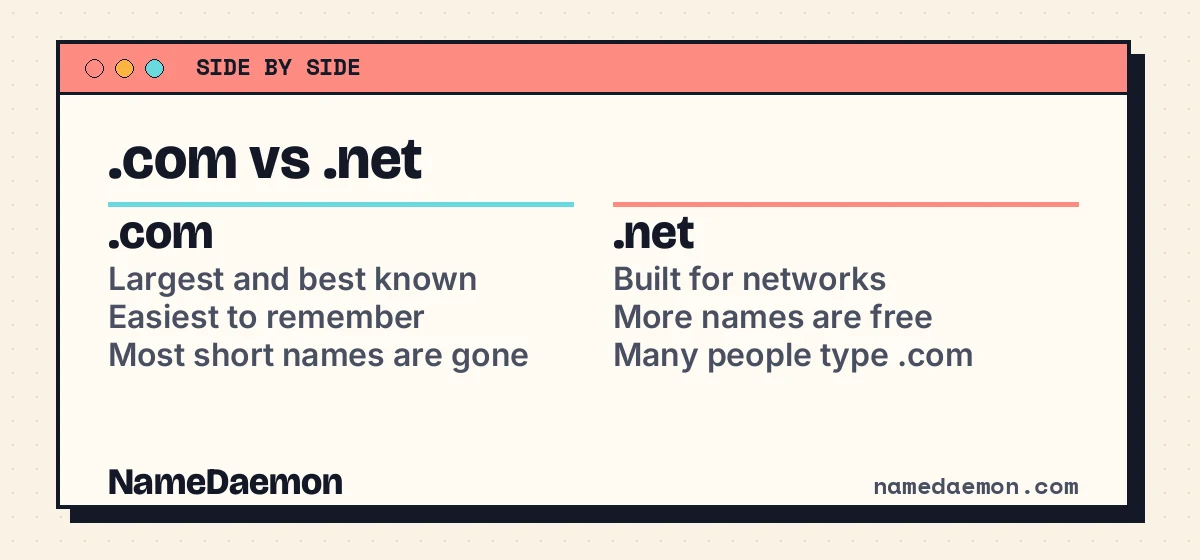
Why .com vs .net is not a close call for most sites
The .com extension is the largest one by far. On 8 October 2026 the zone held 167,343,624 names, and you can see the live number on the State of .com page. People type .com by habit, so a .com name is easier to remember and to share.
The .net extension was meant for network services, but anyone can register it today. Verisign runs the registry for both extensions. They work alike, so the main difference is how people read them. A .net name looks fine for a tech product. For a shop, it can look like a second choice.
When .org is the better choice
The .org extension is open to everyone, too. Still, people tend to link it with nonprofits, clubs and open projects. Public Interest Registry runs it. If your site is about a cause, a community or an open source project, .org builds trust fast.
A company that sells things has a harder time with .org. Visitors may wonder if you are a charity. In that case, the choice between .com, .net and .org usually ends with .com.
What to know about .io and other country codes
The .io extension is a country code. Many tech startups use it, because it looks short and modern. However, country codes follow the rules of their own registry. Those rules, and the prices, can change. Some also limit who can register.
You can read the current record for any extension in the IANA root zone database. Also check the renewal price before you commit. The Domain Cost Calculator shows what each extension costs over several years. For more on this trade-off, see our post on .ai vs .com for a startup.
How people read each extension
Visitors judge a name in a second. The ending is part of that first look. The .com feels familiar and neutral. Visitors read .org as a cause, and .net as a service. Any country code feels like a choice, because it tells people something about you.
This is why the same name can work in one extension and fail in another. Think about your visitors first. Then pick the ending that matches what they expect. You can also test it: say the name aloud with each ending and ask three people what they think the site does.
What a better second choice looks like
Sometimes someone already owns the .com you want. Many people then switch to .net, but there is often a better move. Add a second word that says what you do, and keep the .com. A longer .com is easier to remember than a short name with an unusual ending.
For example, if shopname.com is taken, try shopnamestudio.com or getshopname.com. People guess the .com first. So a clear two-word name wins more often than a clever ending.
How to choose between .com vs .net
Use this short rule. First, try to get the .com name. If it is taken, add a second word rather than switching. Only then look at the others.
Here are the steps:
- Check your name in .com with the Availability Checker.
- If it is taken, try two-word versions that say what you do.
- Only then look at .net, .org or a country code.
- Run the seven checks before you buy.
What to remember
An extension is a top-level domain, and each one has its own rules and prices. The .com is the safe default. The other three have a place when your audience fits them. When in doubt, choose the one your visitors would type first.