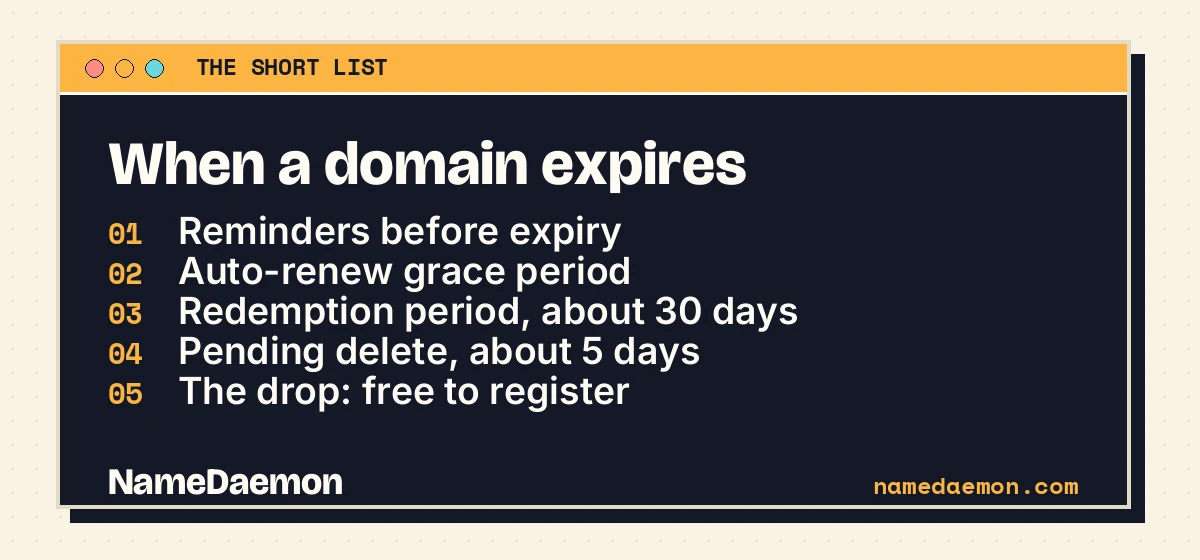
When a domain expires, it does not become free at once. It moves through five stages: reminders, a grace period, the redemption period, pending delete and finally the drop. In the longest case, this takes about 75 to 80 days.
What happens when a domain expires? The short answer
The owner has several chances to renew, and each chance costs more than the last. Only at the end does the name return to the public pool. Timings differ between registrars, so treat the days below as typical, not exact.
| Stage | What happens | Typical length |
|---|---|---|
| 1. Reminders | The registrar warns the owner | Before and just after expiry |
| 2. Grace period | The owner can renew at the normal price | Up to about 45 days |
| 3. Redemption | The owner can restore it for an extra fee | About 30 days |
| 4. Pending delete | Nobody can restore it | About 5 days |
| 5. The drop | The registry deletes it and it is free to register | One daily batch |
Stage 1: the reminders before a domain expires
Registrars must warn owners before a name runs out. The ICANN Expired Registration Recovery Policy asks for at least two reminders. One goes out about a month before, and one about a week before. After the date passes, the registrar must send one more notice within five days.
Many owners miss these emails. They go to an old address or to a spam folder. That is the main reason good names expire.
Stage 2: the grace period
Right after the date, the name often keeps working for a while. The registry calls this the auto-renew period. In it, the owner can still renew at the normal price. It lasts up to about 45 days, but a registrar can end it sooner.
Some registrars park the page or switch off the website during this time. The name still belongs to the old owner, so nobody else can register it. You can read more about the grace period in our glossary.
How long does it take when a domain expires?
Add the stages and you get the timeline. A name in the longest case spends up to 45 days in the grace period, 30 days in redemption and about 5 days in pending delete. That is roughly 80 days from the expiry date to the drop.
A registrar can delete the name earlier. So the real drop can come a month or two after the date. The Drop Calendar shows names that are already near the end, with an estimated day.
Stage 3: the redemption period
If the owner does not renew, the registrar deletes the name. It then enters the redemption period. The owner can still restore it, but the fee is higher. Usually the name leaves the zone and stops working.
The registry shows the status as redemptionPeriod. You can read what each status means on the ICANN page about EPP status codes.
Stage 4: pending delete
After about 30 days in redemption, the status changes to pending delete. Now the owner cannot restore the name. It stays in this state for several days, usually about five. Then the registry deletes it.
This is the stage that matters to buyers. A name in pending delete will drop soon. You can check one for free with the Availability Checker.
Stage 5: the drop
On the last day, the registry deletes the name in a daily batch. Then anyone can register it. Popular names go in seconds, because services send requests straight to the registry. This is the domain drop.
If a name matters to you, place a backorder. A backorder service tries to register the name the moment it drops. Our post on how to buy an expired domain explains how.
Can you rescue a name when a domain expires?
Yes, but the price rises at each stage. In the grace period you pay the normal renewal price. In redemption you pay an extra restore fee. After that, nothing can bring the name back.
So the best moment to act is early. Owners should renew as soon as they see the first reminder. Buyers should wait for the end, because owners often renew at the last minute.
What to do when a domain expires on you
If your own domain runs out, act at once. Renew it in the grace period, because the price is the normal one. Then check that the website and email still work.
Here is a short plan:
- Log in to your registrar and renew the name.
- Turn on auto-renew so it cannot happen again.
- Update the contact email, so reminders reach you.
- Check your email records with the Domain Health Check.
A name in redemption can still be saved, but it costs more. So do not wait for the last day.